
Maximizing Your Return on Investment from Direct Mail Campaigns
By: Leni Weisberg
January 14, 2026Introduction
Direct mail results often feel inconsistent from one campaign to the next. This post breaks down the simple mechanics behind ROI so you can understand what drives strong performance and how to improve it.
Key Topics
Why Direct Mail Results Seem So Up and Down
Lowering Costs Without Hurting Results
Why Direct Mail Results Seem So Up and Down
Imagine you had a slot machine into which you could put $1, and the next day it would spit out $2. You would put every dollar that you had into that machine and would put every dollar that it spits out right back into the machine until it stopped returning double your money.
The principle illustrated by that example is called ROI – return on investment. The investment is the one dollar that you put in and the two dollars that you get back are your return on investment (ROI) – in this case 100%. The more you put in, the more you get out.
Now imagine that every dollar that you put in returned a different amount every time you pulled the lever. Sometimes it returned $50, and sometimes it swallowed your dollar and returned nothing. That’s a more accurate representation of how ROI works in the direct mail marketing world. Sometimes you invest $500 for every $50,000 returned, and sometimes you invest $5,000 and get nothing in return.
How ROI Works in Direct Mail
ROI in direct mail is calculated by taking the total return, subtracting your investment, then dividing the difference by the investment, and finally multiplying that total by 100.
For example, if you spend $10,000 from a mailer that makes $13,000 back, you would calculate ROI like this:
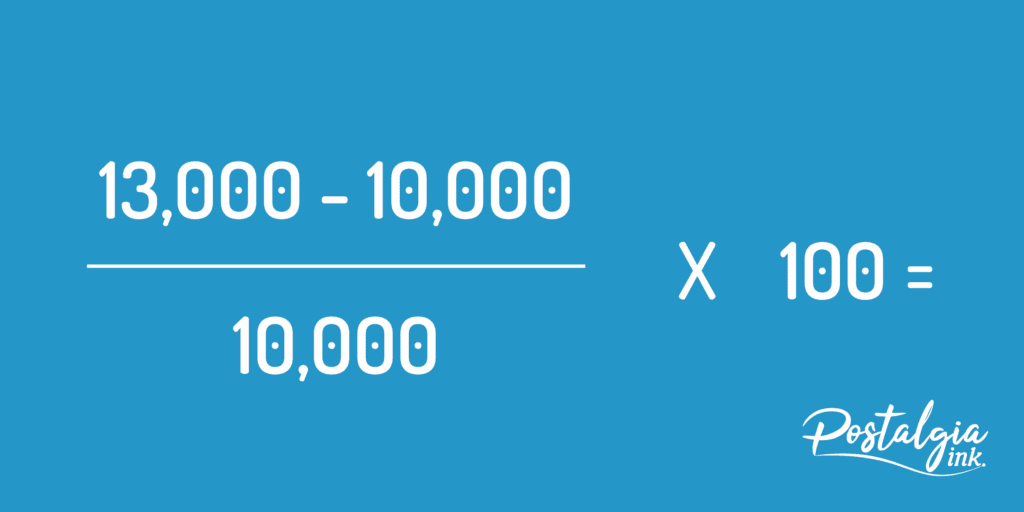
The cost of the mailer – the initial investment ($10,000) – is subtracted from the return ($13,000) to calculate the gain. The gain ($3,000) is then divided by the investment ($10,000) to give a result of 0.3. That 0.3 is multipled by 100 to find the ROI, which is 30%.
The Two Levers That Drive ROI
There are two ways to raise the ROI on a campaign, and they are the two levers that you can play with and tweak to try to get your slot machine to spit out the maximum amount of money for every dollar you put in.
The first is reducing the cost of the campaign without dramatically lowering the effectiveness. If you can find a way to pack the same punch for less money, that’s a great way to raise ROI. You’ll often here people in the fundraising world referring to this as lowering the “cost per dollar raised” (CPDR) – put differently: How much does it cost you to raise one dollar?
This is the mirror-image of ROI (which asks: how much does each dollar invested raise you?) but is ultimately asking the same question in spirit.
The second lever that you can pull to raise ROI is to increase the effectiveness of your campaign without dramatically increasing cost, by using direct mail best practices to increase response rates or gift sizes.
For example, suppose you have a campaign that raises $5,000 at a cost of $2,500. Your ROI is 100%. The next year, you run the same campaign and raise $5000 but your cost is only $2,000. Your ROI is now 150% because you used the first lever to lower costs.
By the same token, maybe the next year you spruce up the piece a bit and sharpen your ask and raise $6,000 for $2,000 spent. Now your ROI is 200%.
Lowering Costs Without Hurting Results
There are hundreds of tried and tested ways to lower costs in fundraising, but the trick is to lower costs without adversely affecting results. For example, many nonprofits have tried to get rid of their direct mail fundraising altogether and replace it with free email, only to find that their costs go from $50,000 to $0, and their returns go from $250,000 to $25,000.
That said, we’ve counseled dozens of nonprofits on how to improve their ROI by lowering costs without sacrificing any effectiveness.
Optimizing your list
One of the best ways to lower costs in direct mail marketing is to optimize your list before you mail a package. Having bad addresses or extra names on your list can cost your organization thousands of dollars.
Thankfully, partnering with a direct mail vendor like Postalgia can result in a better list, better package, less money wasted, and better results.
There are a few different ways to optimize your list:
1. Cleaning your list
2. Deduplicating or householding your list
3. Running your list through NCOA
4. Dropping uninterested prospects from your list
Cleaning your list
When lists are exported from databases, they often have corrupted addresses, missing information, and information placed in the wrong columns, all of which can result in mail not arriving at its destination, or worse – arriving and including incorrect information that offends or otherwise turns off the recipient. Working with an experienced direct mail vendor can help you to avoid these pitfalls.
Using address correction software to correct mailing addresses is table-stakes for any serious direct mail program. While this software can be expensive and is not always user-friendly, your direct mail vendor, like Postalgia, has both the experience and expertise to ensure that your list is clean and correct, and that no undeliverable addresses make it onto your final mailing list.
After your first mailing with Postalgia or a similarly experienced direct mail vendor, you should receive a cleaned and optimized list – called a back feed file – returned to you for future mailings.
Deduplicating and Householding
Almost nothing is a bigger waste of money than having the same recipient go to their mailbox and receive the same piece of mail three or four times all at once, and yet this is a very common occurrence in the direct mail world.
There are all sorts of reasons why a recipient would be on your list or in your database three times. Perhaps they came to two different events and once gave the name “Alex” and another time gave the name “Alexander.” Perhaps a third time they came with their spouse and were listed as “Mr. & Mrs. Smith.” The result is that Alexander Smith is going to get three letters to the same address at the same time: “Dear Alex,” “Dear Alexander,” and “Dear Mr. & Mrs. Smith.”
This is easily avoidable using deduplication software to ensure that each of these records – all at the same address, only receives one package.
Similarly, there is no reason to send yet another package to Mrs. Amanda Smith at the same address.
Using a process called “householding” will allow you to group together all of the individuals who live at the same house into one package, so that “The Smith Residence” receives one package.
This is a great way to save money without sacrificing any effectiveness. After all, it’s not like the Smiths are going to donate four times just because they received four identical packages.
Running your list through the NCOA registry
So now you’ve cleaned your list, and instead of sending a letter to Alex&er Smith, it will go to Alexander Smith, and instead of 4 packages going to the same residence, the Smith family will receive only one package.
The problem is that the Smith family has moved.
If you’re lucky enough to have the new residents forward the mail to the Smith family, it could arrive long after the relevant deadlines have passed. More likely, the package will be returned to sender.
So how do you avoid this pitfall?
The Postal Service keeps a record of people who move from one postal address to another, called the national change of address registry (the NCOA). Direct mail vendors like Postalgia can run your list through the NCOA registry to update address information for people who have moved, like the Smith family, and make sure that they get your mail at their new address.
Dropping uninterested recipients
So now you’ve made sure that the Smith family will get only one package, correctly addressed, and delivered to their new address. There’s still one important way to make sure that you’re not wasting money by mailing the Smiths, and that is to make sure that the Smiths are interested in giving to your cause.
If the Smiths bought a ticket for one event 10 years ago and haven’t donated since, have long since unsubscribed from all digital communications, and have shown no interest in your organization in any way before or after that event, you probably shouldn’t be mailing them 6 or 8 times a year like you might your more active donors or promising prospects.
You may (and probably should) have a lapsed donor program to try to win back lapsed donors like the Smiths but removing them from the house-list mailing is a great way to save money and increase your ROI.
Is there a chance that the Smiths will donate? Maybe a very small, distant chance; but the money you’re spending mailing them could be better spent mailing more or better packages to more promising prospects that have a higher likelihood of resulting in gifts to your organization.
Using better postage rates
Another great way to lower costs without sacrificing any results is to take advantage of better postage rates. For nonprofits, this usually means using nonprofit postage. Nonprofit stamps work just like regular first-class stamps, except they are sometimes a little bit slower to arrive and are much less expensive.
While a first-class stamp is 78 cents as of the time of writing, a nonprofit stamp is just over a quarter of the price at around 20 cents (give or take depending on where the mail is going).
There are a few limitations and hoops to jump through to use nonprofit stamps, but those hoops are well worth jumping through to unlock way better prices. On a list of 10,000 donors mailed 5 times a year, switching to nonprofit postage can save you around $30,000.
The first thing that you need to do is prove to USPS that you are a nonprofit so that you can unlock a nonprofit authorization number, which allows you to mail using nonprofit stamps. This process involves some paperwork, and you can work with a vendor like Postalgia to get this all taken care of quickly and easily.
Once you are ready to mail, you need to ensure that your mail meets USPS’s minimum requirements for nonprofit postage, which includes having at least 200 pieces of deliverable mail, pre-sorting the mail, traying the mail into separate trays based on delivery location, and submitting paperwork when you drop the mail at a USPS business mailing entry unit (BMEU).
If that all sounds complicated, it’s because it certainly can be for a nonprofit to do in house. That’s why so many nonprofits find that working with a direct mail vendor like Postalgia can save them significant money while drastically increasing their ROI. Similar to list cleaning, Postalgia has both the software and the expertise to presort, tray, and induct your mail almost effortlessly.
Even if you’re not using nonprofit postage, presorting your first class mail can get you a much better rate.
Avoiding expensive gimmicks
Here at Postalgia we are constantly running up against conventional wisdom that clients have heard second hand, and would like us to try, despite no or limited evidence that the juice is worth the squeeze.
Some of these gimmicks include using ultra-heavy stock – something that has never been shown to increase response rates. Others include expensive inserts that maybe increase returns a little bit, but offset those returns with drastically higher cost.
One client of ours run an A/B test during a reactivation campaign, with half of their recently lapsed donors receiving an expensive insert. The piece cost them nearly $3.00 per unit, and the ROI was negative at –61%.
In contrast, the other half of their list received a handwritten letter in a handwritten envelope, and the ROI was 363%.
There is always space for testing out and trying new things, but it’s important that those experiments are limited in their scope so as not to cost a fortune.
Avoiding costly mistakes
There are few things more disappointing than cleaning and householding your data, sorting your postage for the best possible rate, using proven methods as well as tried and tested best practices, and then messing up your ROI by screwing up the QR code on the pledge card, or the address on the reply envelope.
It is exceptionally important that when you put together a direct mail package, you work with your mail vendor on proofing. Proofing is the process by which the vendor shows you what your mail is going to look – both to ensure that the artwork and copy are going to accurately reflect what you want when the piece goes to print, and to make sure that all of the variable data and personalizations line up with what you expected. Demonstrations of the artwork are called artwork proofs or print proofs, while proofs that include variable data are called live proofs or live audits.
Skipping the proofing process or failing to pay attention to detail are quick ways to crater your ROI.
Increasing Income From Your Campaign
Of course, if the first lever for increasing ROI is to lower costs, the flip side of the equation is increasing ROI by raising the income that the campaign produces. There are so many tried and tested ways to increase ROI on a direct mail campaign without raising costs.
Raising response rates
When considering how to raise income, it’s important to understand that income on a direct mail fundraising campaign is made up of two factors: increasing response rate and increasing average donation amount.
Increasing response rate means increasing the number of people per every 100 recipients that donate as a result of your campaign. It’s important to note that when measuring this, response rates should not be limited to the people who directly respond to the mailer itself. While attribution can be difficult when gifts come in through other channels, currently it is extremely common for recipients to have their attention captured by a mailer, to be persuaded to give by that mailer, and then to actually execute the gift through a different channel – usually online.
Using convenient response devices to increase response rates
It is common for recipients to decide to give, and then to abandon or indefinitely delay their intention to give at the first sign of resistance. For example, someone gets your package and decides to donate. They are looking for an envelope and stamp to use to mail back the check. They can’t find one, so they decide that they will send in their gift at a later date; later never comes.
Using different reply mechanisms such as a prepaid reply envelope, a QR code, and informed delivery can significantly increase response rates while increasing costs only marginally or not at all.
Using a Business Reply Envelope (BRE)
A business reply envelope (BRE) is a reply envelope that can be nested along with your letter in the outer envelope and has a barcode on it that gets scanned only if it is mailed back. The envelope includes prepaid postage for the recipient to send it back to your address, but your postal account is only charged if the envelope is mailed back.
That way, if you mail 1,000 people, and only 100 of them mail back the envelope, you only pay the postage for those 100 recipients, and not the 900 who didn’t mail you back. Since those 100 reply envelopes presumably have a check in them, you should be more than happy to pay the postage.
Including a prepaid reply envelope – a BRE – in the package can make it significantly easier for your recipients to donate.
Including a QR code
Similarly, including a QR code allows your donors to be persuaded by the tactile experience of receiving a high-quality, attention-grabbing direct mail package, and then to enjoy the convenience of donating digitally by using the supercomputer that they carry around all day in their pocket.
While QR code adoption has not been as strong as many predicted, especially amongst the older generations that make up the bulk of the donors to North American nonprofits, including a QR code doesn’t cost anything extra, and for some folks can be the difference between donating and not donating.
Using Timeliness and Relevance
Another great way to increase response rates is to make your piece timely and relevant to the donor. Silently answer the question “why are you mailing me now.” Seasonality is, of course, a common tool in fundraising; many recipients tend to give at the same time every year (for example around the holidays, the anniversary of an event, or tax season).
Using timeliness and relevance to create urgency in your appeal is also a proven method for increasing response rates (though it should be real urgency, not manufactured). For example, sending a letter raising money for a summer camp program for underprivileged youths in October is not going to inspire urgent giving. Sending the same package in the spring and saying that your organization only has 4 weeks left to offer scholarships, commit to programming, and buy supplies is much timelier, and will have way better results.
Personalization
When surveyed about why they stopped giving to nonprofits, lots of lapsed donors cite reasons like “poor communication,” or “didn’t feel valued,” or “didn’t feel like the organization needed me.” These all point to a growing and disturbing phenomenon of donors feeling like nothing more than a number.
Direct mail has become easier to scale than ever before, but new technology has also made it easier to personalize communications than ever before.
Working with a direct mail vendor like Postalgia can empower you to include variable copy, variable images, personalizations like name, ask amount, and even variable PS messages.
Postalgia specifically can also vary the handwriting style, signature, and make all of your variables handwritten, so that they seem like they were written by an attentive and diligent relationship manager or nonprofit fundraiser.
Getting attention
Like with any pitch in any format, you can’t get the “yes” that you’re looking for if the person being pitched isn’t paying attention.
That’s why open rates are so important in the direct mail world. If the envelope is never opened, the letter is never read; if the letter is never read, the response rate will be zero.
There are lots of ways to make your envelope stand out in the mailbox so that it gets eagerly opened and read.
Of course, working with Postalgia you can hand-address the envelope, which has been proven to have amongst the highest open rates measured. Similarly, using an off-size envelope that looks like an invitation or birthday card, rather than a standard number 10, will get your envelope opened at a much higher rate.
Using postage stamps instead of postal indicias are also a great way to increase open rates, which is why whenever possible we recommend using nonprofit stamps.
Including a clear call to action
One pitfall that many nonprofit fundraisers suffer from is being too subtle. As much as you want to include a robust case for giving in the letter, one of the most common ways that direct mail copywriters lower their response rate is by not including a clear call to action, or by letting their call to action get burried underneath layers of other information.
At the end of the day, your mail package is asking for money, and that ask needs to be clear. Ensure that it includes how much you are asking for (this is a great opportunity to personalize using variable ask amounts), what the money is going towards, and how the donor can donate.
Most importantly: Make sure that you are asking. Don’t hint at the ask, or dance around the ask; ask the recipient to donate.
Raising gift amounts
The other way to increase ROI, after lowering costs and raising response rates, is to raise average gift amounts. There are a few ways to do that, though some can require a heavier upfront investment than a few of the other methods that we’ve discussed here.
Tailoring ask amounts
Like the above advice about personalization, and making a clear ask, it’s important that ask amounts are targeted to the individual and accurately reflect their capacity to give.
Your ask should always include a few different amounts. For many fundraisers, that means: The amount you expect to get, the amount that you would like to get, and the amount that you hope to get.
Often these are some kind of function of past giving. For example, if a donor gave $100 last year, you may ask for $125, $150, or $200 this year, and repeat that pattern of asking for 1.25x, 1.5x, and 2x for every donor on your list.
Similarly, it’s always helpful if the ask amount is tied to something concrete. For example, you may tell a donor that gave $400 last year that a $500 donation allows the organization to send a kid to summer camp for a week, a $600 donation allows us to send them for a week and pay for all of the day trips and camp swag that their friends might have, and $800 allows us to send them to camp for 2 weeks and buy them all the clothes and supplies that they’ll need.
The point is that asking for too little is one of the most frequent sources of getting too little, and one of the easiest ways to raise the average gift amount is by raising the average ask amount.
Include stewardship touchpoints in your direct mail programs
Postalgia has published several case studies, like this one and this one, that show that including stewardship touchpoints like handwritten holiday cards, impact reports, and notecards can drastically increase average gift amount, as well as response rates.
Including stewardship touchpoints, sprinkled throughout the year, are an effective way to make donors feel connected to and a part of your organization, and have been shown to dramatically increase the likelihood that these donors not only donate more often and in higher amounts, but also donate above the ask amount.
Also consider this study from EngageUSA that shows that a well-times thank-you followup and second ask can also have a significant effect on donor response rates and gift amounts.
Pulling It All Together
When creating your direct mail plan, return on investment (ROI) should be top of mind. Measuring it (by subtracting costs from returns and dividing the difference by your initial investment) should be done after every mailer to ensure that you are on top of how well your direct mail program is performing.
You can increase ROI by decreasing costs and avoiding common mistakes and pitfalls. You can also increase ROI by increasing the response rate of your piece and increasing the average gift amounts.
Creating an incredibly profitable direct mail program doesn’t have to be complicated or overly expensive.
Next Step
If you want a deeper walkthrough with checklists and practical examples, you can download our full guide to improving direct mail ROI. It expands on everything covered here and gives you tools you can use in your next campaign.